



What is One Health?
One Health is an approach that recognizes that the health of people is closely connected to the health of animals and our shared environment.
One Health is not new, but it has become more important in recent years. This is because many factors have changed interactions between people, animals, plants, and our environment.
- Human populations are growing and expanding into new geographic areas. As a result, more people live in close contact with wild and domestic animals, both livestock and pets. Animals play an important role in our lives, whether for food, fiber, livelihoods, travel, sport, education, or companionship. Close contact with animals and their environments provides more opportunities for diseases to pass between animals and people.
- The earth has experienced changes in climate and land use, such as deforestation and intensive farming practices. Disruptions in environmental conditions and habitats can provide new opportunities for diseases to pass to animals.
- The movement of people, animals, and animal products has increased from international travel and trade. As a result, diseases can spread quickly across borders and around the globe.
- These changes have led to the spread of existing or known (endemic) and new or emerging zoonotic diseases, which are diseases that can spread between animals and people. Every year, millions of people and animals around the world are affected by zoonotic diseases. Examples of zoonotic diseases include:
- Rabies
- Salmonella infection
- West Nile virus infection
- Q Fever (Coxiella burnetii)
- Anthrax
- Brucellosis
- Lyme disease
- Ringworm
- Ebola
Animals also share our susceptibility to some diseases and environmental hazards. Because of this, they can sometimes serve as early warning signs of potential human illness. For example, birds often die of West Nile virus before people in the same area get sick with West Nile virus infection.
What are common One Health issues in Delaware?
One Health issues include emerging, re-emerging, and endemic zoonotic diseases, neglected tropical diseases, vector-borne diseases, antimicrobial resistance, food safety and food security, environmental contamination, climate change and other health threats shared by people, animals, and the environment. For example:
- Antibimicrobial-resistant germs can quickly spread through communities, the food supply, healthcare facilities, and the environment (soil, water), making it harder to treat certain infections in animals and people.
- Vector-borne diseases are on the rise with warmer temperatures and expanded mosquito and tick habitats.
- Diseases in food animals can threaten supplies, livelihoods, and economies.
- The human-animal bond can help improve mental well-being.
- Contamination of water used for drinking, recreation, and more can make people and animals sick.
- Even the fields of chronic disease, mental health, injury, occupational health, and noncommunicable diseases can benefit from a One Health approach involving collaboration across disciplines and sectors.
How does a One Health approach work?
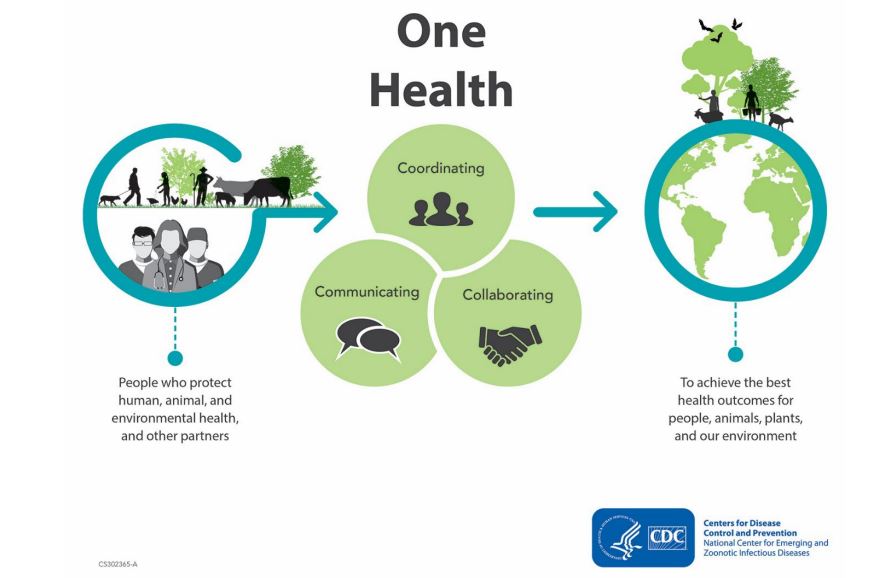
The Foundation of One Health:
- Communication
- Coordination
- Collaboration
Among human, animal, environmental health, and other relevant partners. One Health is gaining recognition in the United States and globally as an effective way to fight health issues at the human-animal-environment interface, including zoonotic diseases. CDC uses a One Health approach by involving experts in human, animal, environmental health, and other relevant disciplines and sectors in monitoring and controlling public health threats and to learn about how diseases spread among people, animals, plants, and the environment.
Successful public health interventions require the cooperation of human, animal, and environmental health partners. Professionals in human health (doctors, nurses, public health practitioners, epidemiologists), animal health (veterinarians, paraprofessionals, agricultural workers), environment (ecologists, wildlife experts), and other areas of expertise need to communicate, collaborate on, and coordinate activities. Other relevant players in a One Health approach could include law enforcement, policymakers, agriculture, communities, and even pet owners. No one person, organization, or sector can address issues at the animal-human-environment interface alone.
The One Health approach can:
- Prevent outbreaks of zoonotic disease in animals and people.
- Improve food safety and security.
- Reduce antibimicrobial-resistant infections and improve human and animal health.
- Protect global health security.
- Protect biodiversity and conservation.
By promoting collaboration across all sectors, a One Health approach can achieve the best health outcomes for people, animals, and plants in a shared environment.
DPH Invites Healthcare Providers to its New Monthly Reportable Disease Forum
The Division of Public Health’s Office of Infectious Disease Epidemiology (OIDE) now has office hours for Delaware health care providers.
Every month, OIDE hosts an accessible and informative platform for health care providers to engage with epidemiologists and other experts to stay informed about key public health topics.
The monthly “EpiChat” forum for Delaware health care providers to learn about Delaware’s reportable diseases, ask questions, and share insights. Resources will be shared.
During these meetings, OIDE will provide information and guidance on various public health topics. The EpiChat series will feature online discussions with epidemiologists and subject matter experts via Delaware Public Health’s One Health partnership.
On February 22 at Noon, the EpiChat will focus on West Nile Virus transmission, surveillance, reporting, and mosquito control and prevention.
The March 21 at Noon, EpiChat will feature Lyme disease’s epidemiology, geographic distribution, clinical presentation, diagnosis, and treatment; and tick prevention and control.
To receive Epichat notifications, contact Reportdisease@delaware.gov
For more information, contact OIDE at 302-622-4149
Register below!
April 18, 2024
May 16, 2024
Healthy Summer: https://events.gcc.teams.microsoft.com/event/87df786c-0865-4df7-80d8-f5fa92236012@8c09e569-51c5-4dee-abb2-8b99c32a4396
June 20, 2024
July 18, 2024
Viral Hepatitis: https://events.gcc.teams.microsoft.com/event/49e75a58-8a6d-4b90-9ed9-aaea7766ef73@8c09e569-51c5-4dee-abb2-8b99c32a4396
August 15, 2024
Vaccine Preventable Disease: https://events.gcc.teams.microsoft.com/event/323c6ce3-ccb0-474e-8a2b-f79cfb892c9a@8c09e569-51c5-4dee-abb2-8b99c32a4396
September 19, 2024
Fungal Diseases: https://events.gcc.teams.microsoft.com/event/7525205f-7d36-4d8e-9792-2525e52c8873@8c09e569-51c5-4dee-abb2-8b99c32a4396
October 17, 2024
Respiratory Season: https://events.gcc.teams.microsoft.com/event/2b708523-381e-4f78-86d8-6b8719d3b4c8@8c09e569-51c5-4dee-abb2-8b99c32a4396
November 21, 2024
What is One Health: https://events.gcc.teams.microsoft.com/event/8462042d-d032-46e6-b3f8-710dc1aa6c14@8c09e569-51c5-4dee-abb2-8b99c32a4396
December 19, 2024
Healthcare-Associated Infections: https://events.gcc.teams.microsoft.com/event/967d416d-5f02-42bc-94d9-8720bcfcee21@8c09e569-51c5-4dee-abb2-8b99c32a4396
Office of Infectious Disease Resources
Provider Education
Related Resources
Office of Infectious Disease Epidemiology
24/7 Emergency Contact Number: 1-888-295-5156